

The Shapie Journal
Large LED Wall Art for a Living Room: Choosing a Statement Piece
Large LED wall art gives a living room a clear focal point: a full canvas composition in daylight and selected illuminated details in the evening. The right piece has enough presence for the wall while leaving space around it and working with the furniture below.
A substantial sofa or sideboard can make a painting look smaller than it did on a product page. If the wall allows it, choosing a larger format can give the image room to be appreciated from your usual seat.
Start with the room’s proportions and the way you use it. Size, composition and the night effect all contribute to how the artwork will feel once it is part of your home.


Choose the wall before choosing the canvas
Look for a position where the complete painting will remain visible. Above a sideboard, on a clear wall beside a seating area or opposite your favourite chair can each offer a different viewing experience.
Measure the usable space between shelves, corners, switches and nearby furniture. Then look from the doorway and from where you sit. A wall can have plenty of physical space but still feel crowded when several objects compete for attention.
Decide whether the painting will lead that part of the room or share it with another feature. A large illuminated canvas is easier to appreciate when nearby decorations give it some visual space.
Test a larger size on the actual wall
When you have two plausible sizes in mind, mark out both with removable tape or paper. Include the outer frame dimensions if you plan to choose one.
Live with the outlines long enough to see them in daylight and with your evening lamps on. Step back to your normal viewing distance rather than judging only from directly in front of the wall.
As a planning example, a 120 cm-wide painting is about 47 inches across. On a 180 cm-wide sideboard, that would leave roughly 30 cm of furniture visible on each side when centred. This is a comparison to try on your wall, not a rule or a promise that a particular design comes in that size.
If the smaller outline feels lost and the larger one still leaves comfortable space around it, the larger format may be the better fit.
Compare the complete framed dimensions
Canvas size and overall framed size are different measurements.
The Shapie’s size guide explains that an external frame adds 3 cm to the overall width and height. For example, a 50 × 75 cm canvas measures 53 × 78 cm with that frame.
Check the dimensions for your chosen version before deciding on its final position. The additional frame width matters when a painting sits between fixtures or close to the edge of a sideboard.
Let the composition guide the orientation
A landscape canvas can connect naturally with wider furniture. A portrait piece can give a tall section of wall more presence. A square composition creates a different balance again.
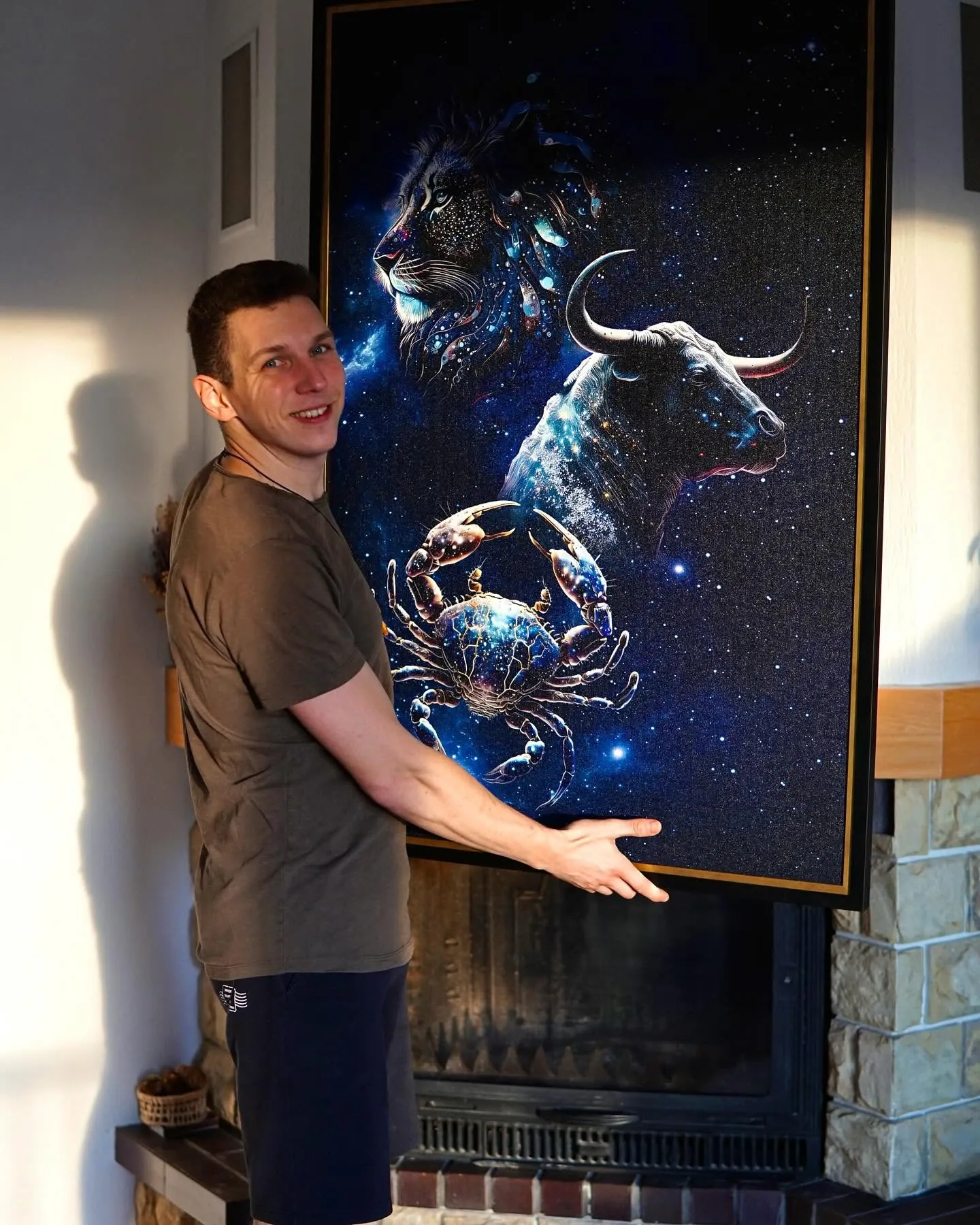
Choose around the image as well as the room. The lion artwork photographed here uses a wide format to give its face and mane space across the canvas. In a portrait, the main figure or subject may benefit from height instead.
Notice how the image reads from a distance. Larger formats can help you appreciate detailed artwork, but clear composition still matters. The parts you like most should remain easy to notice from your usual viewpoint.
Choose the daytime colours with confidence
A statement piece does not need to match every object in the living room.
You might repeat one colour from a cushion, rug or chair, or let the canvas introduce the room’s strongest accent. The geometric lion combines bright colours with a dark background, making the subject prominent without filling every part of the image with equal detail.
Look at genuine daylight photographs before deciding. They help you judge the printed image and physical frame separately from the illuminated effect.
If you want a broader starting point, read how to choose wall art for your home.
Give the evening view its own consideration
Large illuminated wall art introduces another composition when the main room lights are lower.
In the lion’s night photograph, coloured geometric lines define the face and mane. The canvas is experienced through its illuminated details rather than through exactly the same balance of colours you see in daylight.
Compare both views of the design you intend to order. Then think about the lamps and screens nearby. A larger painting can have plenty of presence without needing its highest brightness setting.
Our guide to smart LED wall art explains how dimming and timed controls can help the lighting suit an evening routine.
Make the final position practical
Before mounting the canvas, plan its power connection and how you will reach it when needed.
A rechargeable painting can operate without a connected cable while using its battery, but charging access still matters. A wired version needs a suitable power connection. Check the power options alongside the size you are considering.
Explore The Shapie’s LED wall art to compare subjects, formats and day and night views. For an idea built around your own space or a personal subject, discuss a custom painting and confirm the available format before ordering.
A few practical questions
Should I choose the biggest painting that fits?
Choose the largest of your suitable options that still works with the room’s proportions and leaves space around it. Test the complete outline on the wall first.
Is a landscape canvas always best above a sofa?
No. It can suit wide furniture, but the wall shape, composition and nearby objects also matter. Compare portrait and landscape outlines if both are practical.
Can I judge the size from an interior photograph?
Use photographs to understand the design and its effect, then use measurements to choose the size. Camera angle and distance can change how large a painting appears.